
Why Choose Non-Traditional Tours for Real Cultural Connection

Non-traditional tours are defined as immersive, participatory travel experiences that prioritize direct engagement with local culture, communities, and everyday life over passive sightseeing. Where a conventional bus tour delivers landmarks at a distance, a non-traditional experience puts you inside the rhythm of a city. You cook with a local family in Mexico City, hunt for vintage finds in Barcelona’s hidden markets, or join a street food walk through Hanoi’s Old Quarter. The reasons why choose non-traditional tours come down to one core truth: active participation creates memories that outlast any photograph. Research, brands like Rbantours, and a growing body of traveler behavior studies all confirm this shift in what meaningful travel actually looks like.
Why non-traditional tours deliver richer travel experiences
Non-traditional tours, also called community-based or experiential tours in the travel industry, succeed because they engage travelers on multiple levels at once. A 2026 study of 406 tourists in Vietnam found that four experiential value dimensions, specifically sensory, affective, behavioral, and intellectual engagement, all drive positive attitudes and participatory behaviors. That means the more a tour activates your senses, emotions, and curiosity simultaneously, the more you feel the experience was worth your time and money.
Authenticity is the engine behind this effect. A 2026 study of 380 visitors in local food tourism found that authenticity, cultural experience quality, and food quality are the strongest predictors of both satisfaction and repeat visit intentions. This is not a soft, feel-good finding. It means travelers who connect with genuine local culture are statistically more likely to return and recommend the destination to others.
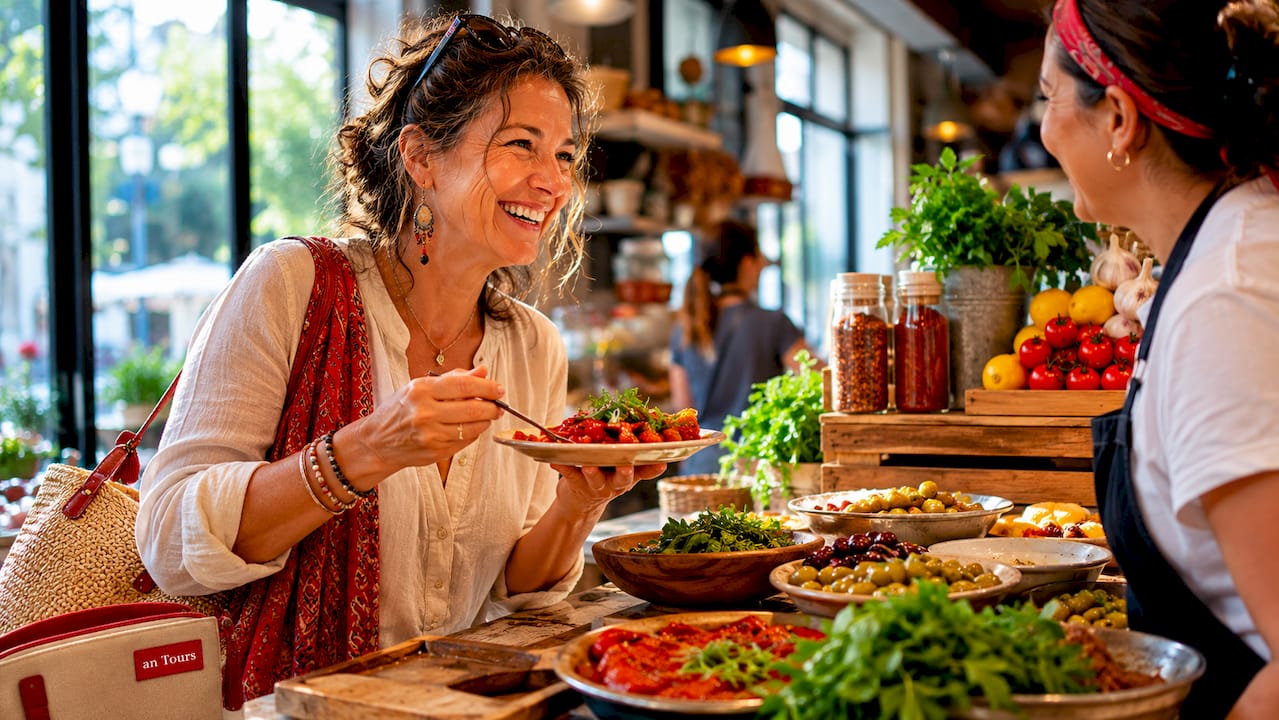
The benefits of unique tours also show up clearly in agritourism research. A 2026 MDPI study with 398 visitors demonstrated that experiential marketing, the kind built around hands-on participation rather than observation, significantly increases perceived value and overall satisfaction. Perceived value is the traveler’s internal calculation of whether the experience was worth the cost. Participatory tours consistently score higher on this measure than passive alternatives.
What makes this work psychologically is the shift from spectator to participant. When you knead dough in a Neapolitan kitchen or learn to read a souk in Marrakech, you are not consuming a destination. You are co-creating a memory with the people who live there. That distinction is the heartbeat of non-traditional travel.
Sensory engagement: tastes, textures, and sounds that anchor memories far more effectively than visual-only experiences
Affective connection: emotional bonds formed with local hosts that outlast the trip itself
Intellectual stimulation: learning a craft, a recipe, or a cultural practice that gives context to everything else you see
Behavioral participation: doing something alongside locals rather than watching them perform for you
Pro Tip: Before booking any tour, ask the operator to describe one specific moment where you will actively participate rather than observe. If they cannot answer concretely, the experience is likely more passive than it appears.
Traditional guided tours vs. non-traditional immersive experiences
The difference between a traditional guided tour and a non-traditional alternative is not simply about group size or price. It is a fundamental difference in purpose and outcome.
Traditional tours are designed around efficiency and accessibility. They move groups through a curated list of landmarks, provide historical context through a guide’s narration, and minimize logistical friction. For first-time visitors to Rome or Paris, this format has genuine value. You cover ground quickly, stay safe, and leave with a solid orientation to the city.
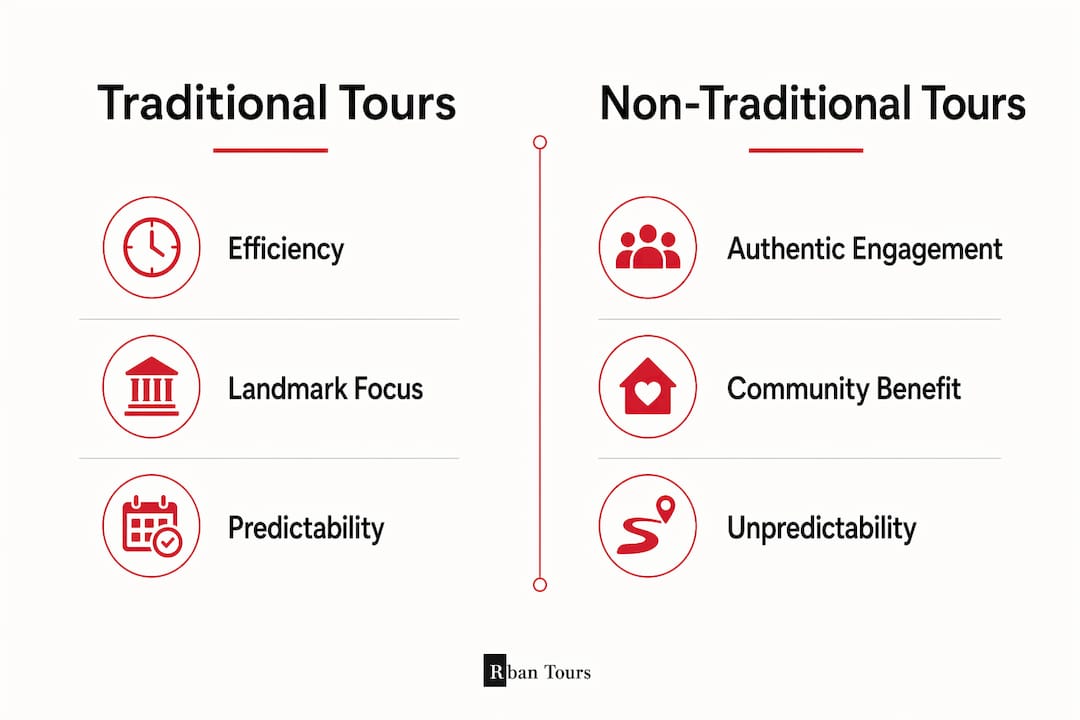
Non-traditional or community-based tours are designed around depth and connection. The itinerary is often flexible, the group is smaller, and the host is typically a local resident rather than a licensed tour guide. The goal is not to see the most sites but to understand one neighborhood, one craft, or one culinary tradition from the inside. Rbantours, for example, builds experiences around local creatives, independent venues, and neighborhood rhythms rather than top-ten attraction lists.
Feature | Traditional guided tours | Non-traditional immersive tours |
Primary goal | Landmark coverage and historical overview | Cultural depth and personal connection |
Group size | Large (15 to 50 people) | Small (2 to 12 people) |
Itinerary flexibility | Fixed and pre-scheduled | Adaptable to group interests |
Host profile | Licensed tour guide | Local resident, artisan, or community member |
Traveler role | Passive listener and observer | Active participant and co-creator |
Satisfaction driver | Information delivery | Authentic engagement and emotional resonance |
The trade-off is real. Traditional tours offer predictability and breadth. Non-traditional tours offer unpredictability and depth. For travelers who want to feel the pulse of a city rather than photograph its surface, the advantages of alternative travel are clear and research-backed.
What to look for when choosing non-traditional tours
Not every tour marketed as “authentic” or “local” delivers genuine immersion. The industry has a commodification problem: operators borrow the language of community-based travel without the substance. Here is how to tell the difference.
Active value co-creation. The best non-traditional tours give you a real role in shaping the experience. Research on sustainable tourism experiential value shows that tours where travelers actively share knowledge, make decisions, and interact meaningfully with the community produce the highest satisfaction scores. Look for tours where your input changes the direction of the day.
Local host involvement. The guide should be a community member, not a contractor hired to perform local identity. Traveling with local hosts creates a fundamentally different dynamic: you gain access to perspectives, spaces, and stories that no outsider could script.
Transparent cultural context. Leading non-traditional tours make authenticity explicit and comprehensible rather than relying on atmosphere alone. According to local food tourism research, tours that explain the cultural “why” behind each experience, not just the “what,” produce deeper satisfaction and stronger loyalty. Ask operators how they communicate cultural context during the experience.
Community governance and benefit-sharing. A genuinely community-based tour is one where local people have a voice in how the tour is designed and where the revenue goes. Operators like Queen Safaris publish explicit community policies that show how tourism income is distributed. This level of transparency is a strong signal of integrity.
Sustainability over spectacle. Avoid tours that prioritize visual drama or Instagram moments over genuine engagement. The most memorable non-traditional travel experiences tend to be quieter, slower, and more personal than their marketing suggests.
Pro Tip: Search for the operator’s local partners by name. If a tour company cannot name the artisans, venues, or community organizations it works with, the “local” element is likely surface-level.
How non-traditional tours benefit local communities
The advantages of alternative travel extend well beyond the individual traveler. When done well, non-traditional and community-based tours generate real economic and social value for the places they operate in.
A 2025 MDPI study in the Pamirs found that community-based ecotourism improves local resilience by generating income, creating employment, and increasing environmental awareness among residents. These are not marginal effects. In regions where traditional livelihoods are under pressure, tourism designed around community participation can be a meaningful economic lifeline.
The social benefits are equally significant. When travelers engage directly with local artisans, cooks, and guides, they create demand for skills and knowledge that might otherwise fade. A vintage textile workshop in Oaxaca or a fermentation class in Kyoto does not just entertain visitors. It sustains a craft tradition and the livelihood of the person teaching it.
However, the picture is not uniformly positive. A 2026 Frontiers study in Zanzibar found that when local voices and resource access are marginalized in tourism planning, negative attitudes and socio-cultural tensions can develop even when economic benefits exist. This is a critical warning for travelers: choosing a tour that claims community connection is not enough. The community must actually govern and benefit from it.
Choose operators who name their local partners and describe how revenue is shared
Prioritize small-group formats that minimize environmental and social pressure on host communities
Ask whether local residents had input into how the tour was designed
Avoid tours that treat cultural practices as performance rather than living tradition
Support operators who invest in local training and capacity building alongside the tourism experience
Key takeaways
Non-traditional tours deliver measurably higher satisfaction, deeper cultural connection, and greater community benefit than conventional alternatives, provided they are built around genuine local participation and transparent authenticity.
Point | Details |
Experiential engagement drives satisfaction | Sensory, affective, and intellectual participation consistently increases perceived value and loyalty. |
Authenticity is the core differentiator | Cultural context and genuine local involvement predict revisit intentions more reliably than logistics or price. |
Value co-creation separates real from staged | Tours where travelers actively shape the experience produce the strongest satisfaction outcomes. |
Community governance matters | Tours with local voice and equitable benefit-sharing create positive outcomes for both travelers and hosts. |
Vetting operators is non-negotiable | Named local partners, transparent policies, and concrete participation moments distinguish genuine immersion from marketing. |
What we have learned from years inside these experiences
The most common mistake travelers make is confusing proximity with connection. You can stand three feet from a local artisan and still feel like a tourist if the interaction is scripted. What actually creates a lasting memory is the moment when the structure falls away: when the cook asks what you think of the spice level, when the guide takes a detour because something interesting is happening on a side street, when the plan changes because the people around you made it change.
We have seen this across every destination Rbantours operates in, from Barcelona to Vietnam to Mexico City. The experiences that generate the most genuine enthusiasm from guests are rarely the most elaborate. They are the ones where something unplanned happened and the local host knew exactly how to make it meaningful. That kind of responsiveness cannot be scripted. It comes from deep community roots and a genuine investment in the traveler’s experience.
The uncomfortable truth about non-traditional travel is that it requires something from you. You have to show up with curiosity rather than a checklist. You have to be willing to eat something unfamiliar, ask a question that might sound naive, or sit with the discomfort of not understanding everything immediately. The travelers who get the most from these experiences are the ones who treat the local host as a collaborator rather than a service provider. That shift in posture changes everything.
Vetting operators matters, but so does vetting yourself. The best tour in the world will feel flat if you approach it as a consumer. Approach it as a guest in someone’s home, and the city opens up in ways no guidebook can map.
— Rban
Discover your next immersive experience with Rbantours
Rbantours designs every experience around one question: what does this city feel like when you live it from the inside? From Barcelona’s creative neighborhoods to the street food culture of Mexico City, each tour is built with local partners who bring genuine knowledge, personality, and community roots to every moment.
[
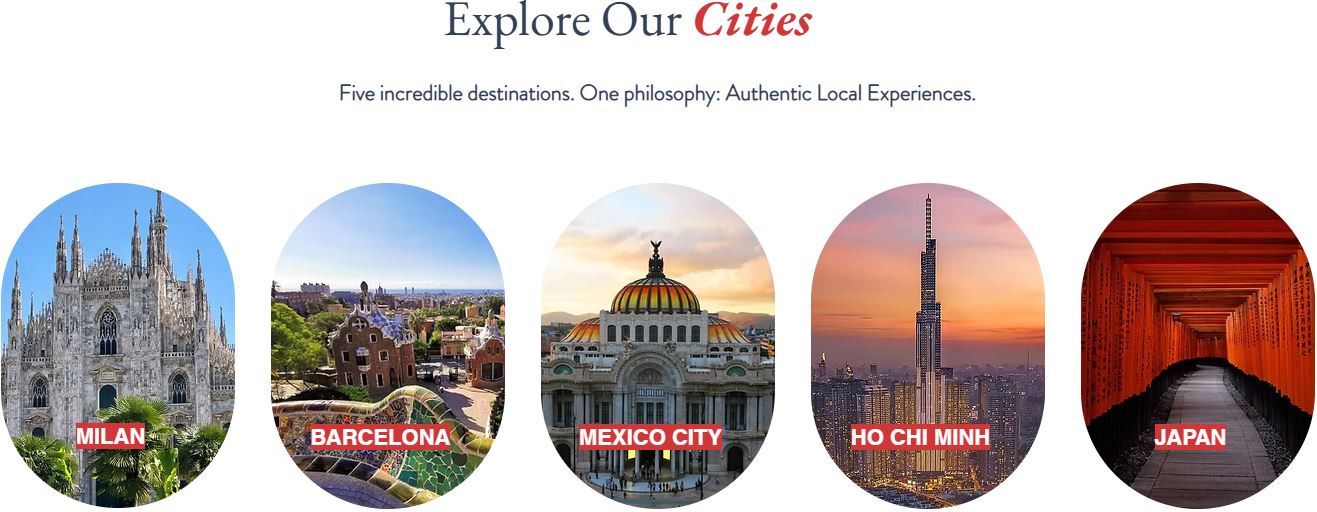
Whether you are drawn to vintage markets, culinary deep-dives, or creative workshops like Paint & Sip, Rbantours connects you with the rhythm of a destination in a way that stays with you long after you leave. Explore curated Barcelona tours or discover the energy of Mexico City through the eyes of people who call it home. Your next meaningful travel experience starts here.
FAQ
What are non-traditional tours?
Non-traditional tours are immersive, participatory travel experiences centered on authentic local culture, community engagement, and active involvement rather than passive sightseeing. They are also called community-based or experiential tours in the travel industry.
Why do non-traditional tours create stronger memories?
Research shows that experiential value dimensions including sensory, affective, and intellectual engagement drive significantly higher satisfaction and loyalty than observation-only formats. Active participation anchors memories more effectively than passive consumption.
How do I know if a tour is genuinely community-based?
Look for named local partners, transparent revenue-sharing policies, and concrete moments of active participation described in the tour details. Operators who cannot name their community collaborators are likely offering staged authenticity rather than genuine immersion.
Are non-traditional tours good for local communities?
When designed with local governance and equitable benefit-sharing, community-based ecotourism generates income, employment, and environmental awareness. Poorly managed tours can create tension, so choosing operators with clear community policies is critical.
How do non-traditional tours compare to traditional guided tours?
Traditional tours prioritize landmark coverage and historical overview for large groups. Non-traditional tours prioritize cultural depth, small group sizes, and local host connections that produce higher satisfaction and more personal travel memories.
Recommended
Comments